

icon icon icon icon icon icon icon

Training Empowers Hadhramout’s Fishermen to Thrive

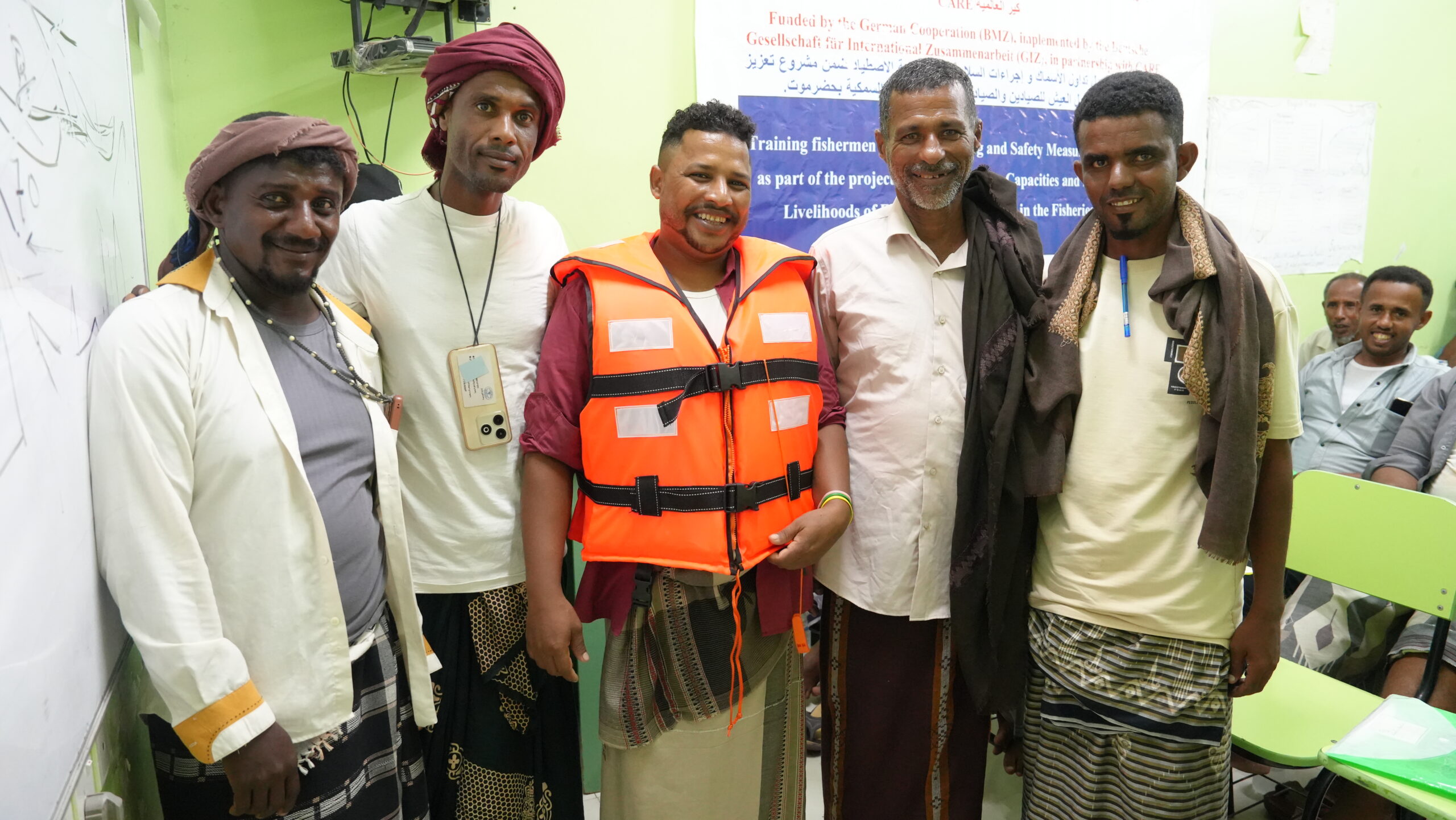
Hamad with the trainee fishermen during training, Al-Muklaa. Photo Credit: Bassam Saleh/CARE.

Hamad with the trainee fishermen during training, Al-Muklaa. Photo Credit: Bassam Saleh/CARE.

Hadhramout Governorate is a vast and historic region located in the eastern part of Yemen, stretching from the Arabian Sea coast deep into the desert interior. For generations, families in Mukalla district of Hadhramout and surrounding districts have relied on the sea to survive. Yet, for many fishermen, the lack of modern skills and safety knowledge has made life increasingly difficult.

Hamad, a fisherman from Mukalla, knows these challenges all too well. “Before the training, we depended on old methods passed down from our fathers,” he recalls. “We didn’t know how to handle fish properly or keep ourselves safe at sea. Many of us lost income because our catch spoiled before reaching the market.”

CARE, in partnership with GIZ[1] and funded by BMZ[2], implemented the Strengthening Capacities and Diversifying Livelihoods of Fishermen and Women in the Fisheries Sector in Hadhramout project. A total of 3,750 fishermen have been reached through this project, aiming to improve economic opportunities, enhance food security, and promote sustainable fishery practices.

Hamad joined training sessions focused on fish handling, post-harvest techniques, and safety at sea. These sessions introduced modern practices that were previously unknown to many local fishermen. “We learned how to use fishing tools better and identify areas rich in fish,” Hamad says. “It was challenging but extremely valuable.”
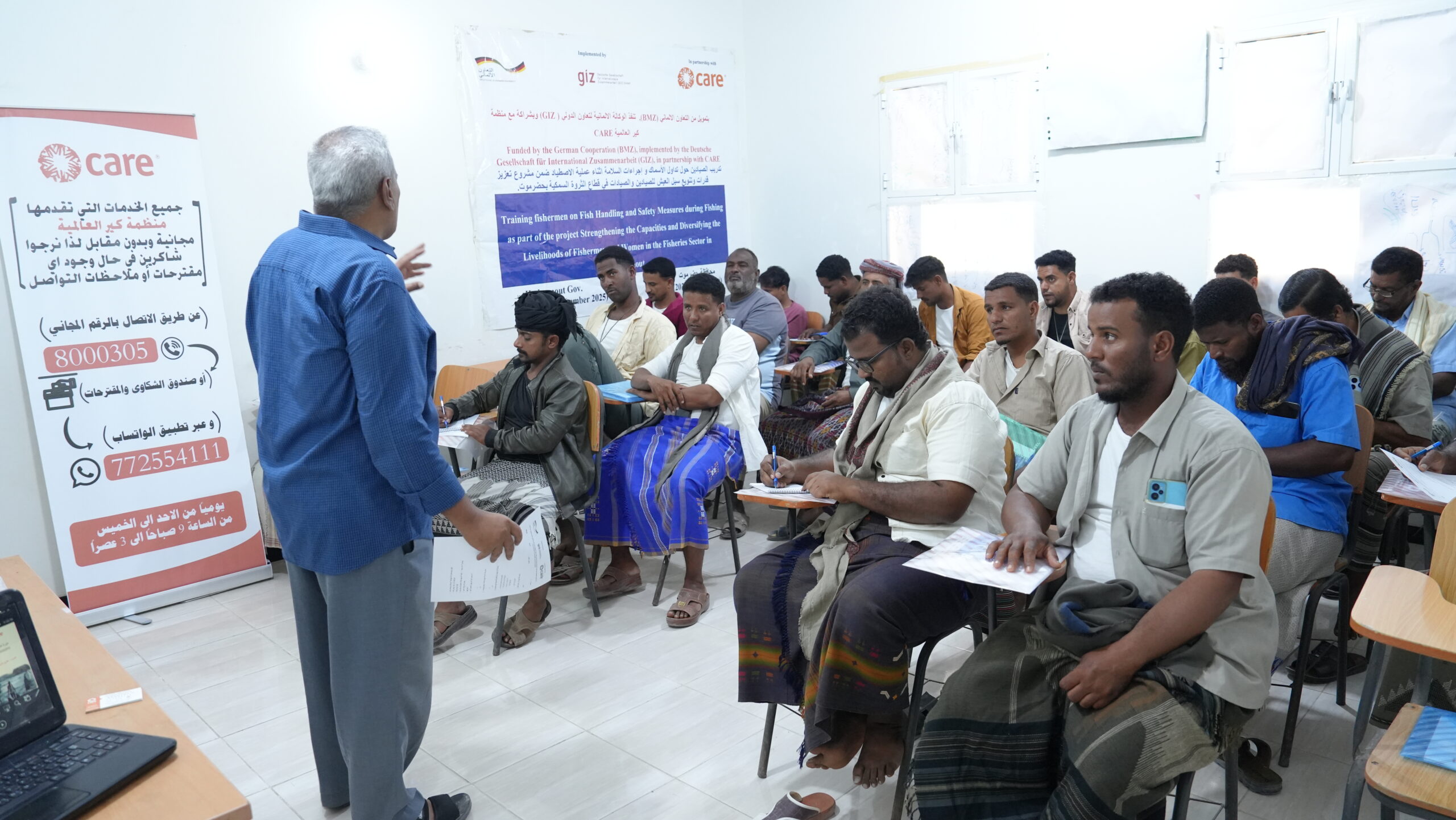
Hamad with the trainee fishermen during training, Al-Muklaa. Photo Credit: Bassam Saleh/CARE

The training did not stop at fishing techniques. It covered financial management, engine maintenance, and occupational health and safety, skills that empower fishermen to sustain their livelihoods. “After the training, I understood the importance of handling fish correctly. Now, I can keep my catch fresh and sell it at better prices,” explains Hamad.

For fishermen in Hadhramout, such knowledge is critical. The sea is their lifeline, but without proper skills, it can also be dangerous. “We used to go out without life jackets or navigation lights. If something happened, we had no way to protect ourselves,” another fisherman added. “Many of us didn’t know how to maintain our engines. A breakdown at sea could mean hours stranded without help.” These hardships highlight why training programs are not just helpful, they are essential.

Like all the trainees, Hamad received practical tools like iceboxes, navigation lights, and life jackets, which have transformed his work. “Now, I catch more fish and earn more income,” he says proudly. “I can provide for my family.”

The impact goes beyond Hamad’s household. Inspired by his experience, he shares his knowledge with others in his community. “We hope to be an inspiration to young fishermen,” he says. “Knowledge is power, it will help fishermen improve their future.”

For the people of Hadhramout, where thousands depend on the sea for survival, these trainings are a lifeline. They ensure that fishermen can work safely, protect their resources, and secure better incomes. “Without this knowledge, we risk our lives and lose our livelihoods. With it, we have hope,” concludes Hamad.

[1] Deutsche Gesellschaft für Internationale Zusammenarbeit (GIZ) GmbH

[2] German Federal Ministry for Economic Cooperation and Development (BMZ)

Back to Top